

For a lot of high earners, the biggest pool of investable money is not the checking account, it is the retirement account: an IRA, or an old 401(k) from a previous employer. And almost all of it is sitting in the same place, the public stock market. A self-directed IRA is the tool that lets you move some of that capital into private real estate, without an early-withdrawal penalty.
It fits naturally with the question of how much of your portfolio belongs in private real estate, because your retirement accounts are part of that portfolio too.
1. What a self-directed IRA actually is
A self-directed IRA (SDIRA) is a regular IRA with one difference: it is held at a specialized custodian that permits alternative assets, including private real estate and syndications, not just stocks and funds. You still get the same tax treatment, traditional (tax-deferred) or Roth (tax-free growth), and you can typically fund it by rolling over an old 401(k) or transferring an existing IRA. The “self-directed” part means you choose the investments; the custodian handles the administration.
2. How it invests in a syndication
When your SDIRA invests in a deal, the custodian holds the investment in the name of your IRA, not in your personal name. Your contribution comes from the IRA, and every distribution and eventual gain flows back into the IRA. If it is a Roth, that growth is potentially tax-free. If you are new to the underlying structure, our guide to how real estate syndication works explains what your IRA is actually buying.
3. The rules you have to respect
A qualified custodian is required. You cannot hold the asset personally. A self-directed custodian administers the account and processes the paperwork, but does not give investment advice or vet deals for you.
No self-dealing. The IRA cannot transact with “disqualified persons,” which includes you and close family. You cannot live in, personally use, or do your own work on IRA-owned property. It must be a genuine investment, at arm’s length.
Money stays in the IRA. All income returns to the IRA and all expenses are paid from it. Mixing personal and IRA funds is a prohibited transaction and can disqualify the whole account.
4. The tax wrinkle most people miss: UDFI
Here is the detail even experienced investors overlook. Inside an IRA, ordinary rental income and capital gains are generally shielded. But most syndications use a mortgage, and the portion of income attributable to that borrowed money can be subject to a tax called UDFI (unrelated debt-financed income), reported on Form 990-T. Illustratively, if a property is 65% leveraged, roughly that share of the income may be exposed, though depreciation and expenses offset much of it, and the first $1,000 is exempt. It is usually a manageable cost rather than a dealbreaker, and notably a Solo 401(k) is exempt from UDFI on leveraged real estate, which is why some investors use one instead. This is a conversation to have with your CPA before you invest.
5. Traditional or Roth?
The choice matters. A traditional SDIRA defers tax until you take distributions in retirement. A Roth SDIRA is funded with after-tax dollars, and qualified growth comes out tax-free, which can be powerful for an asset that both produces income and appreciates over a long hold. Many investors like pairing the tax-advantaged nature of real estate, described in The 2026 Tax Playbook, with the tax-free wrapper of a Roth.
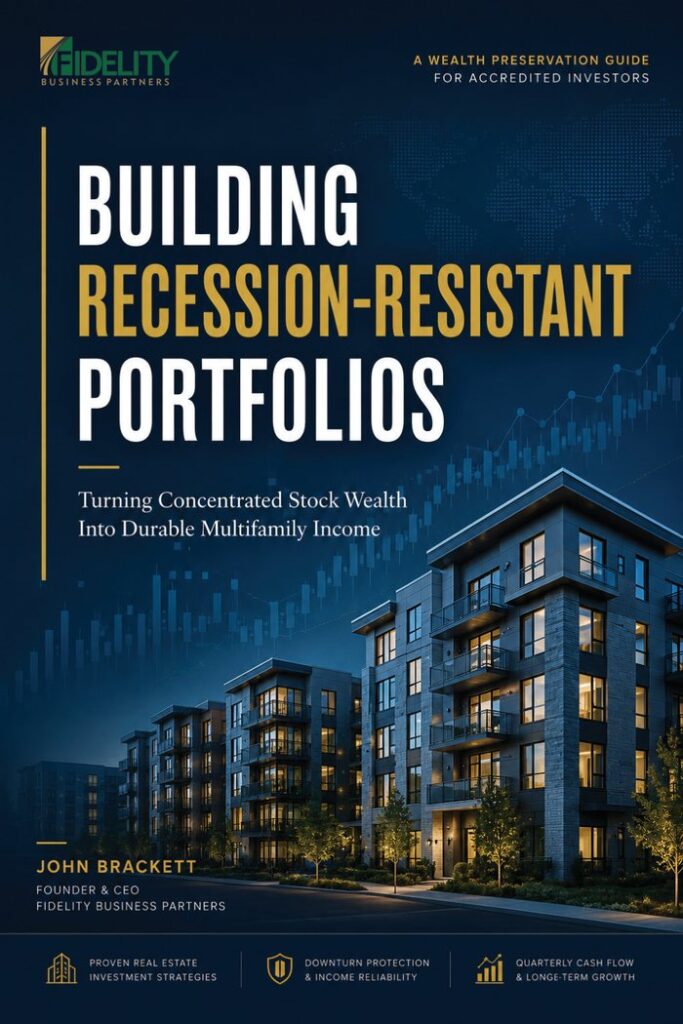
Building Recession-Resistant Portfolios
See how accredited investors use private multifamily to add durable, tax-advantaged income to a stock-heavy portfolio, with the frameworks we use to evaluate every deal.
Get Instant Access →The bottom line
A self-directed IRA lets you invest retirement money in private real estate while keeping the account’s tax advantages, funded by rolling over an old 401(k) or an existing IRA. Respect the rules (a real custodian, no self-dealing, all money through the IRA), plan for UDFI if the deal uses leverage, and weigh traditional against Roth. Done right, it turns your largest, most concentrated pool of capital into a more diversified one.
Put Retirement Capital to Work
Fidelity Business Partners works with accredited investors, including those investing through self-directed retirement accounts, in recession-resistant multifamily assets.
View Current Offerings Get in Touch